![]() ![]()
![]()
|
|
Joe's Red and Yellow
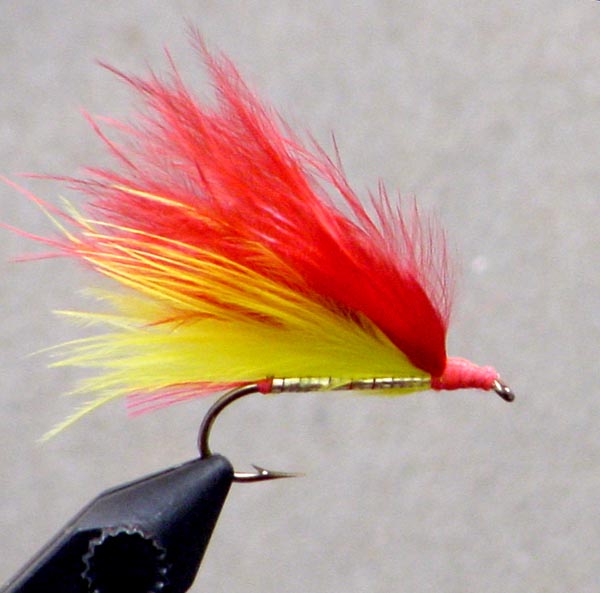
Hook: Mustad 9672 (it's a 3x long streamer hook) Thread: red or orange Tail: red thread (optional) Body: gold or silver tinsel Wing: red marabou over yellow marabou Head: red or orange thread Joe writes; I'm in Maryland, and my shad fishing is typically for hickory shad, a smaller cousin of the American shad. A big hickory would be about 2 pounds as opposed to 5 or more for the bigger species. Starting in April, the shad come into the Chesapeake Bay and slowly make their way northward until reaching the Susquehanna River at the head of the bay. The Susquehanna is a big River here, reaching hundreds of miles northward into Maryland, Pennsylvania, and New York. Father up, it's an outstanding and renowned smallmouth bass fishery (home of Bob Clouser) but I'm down near the mouth where it enters the Chesapeake. A few miles upriver from the Bay are a couple tributaries, Deer Creek and Octoraro Creek, on more or less opposite sides of the river, and barely above the tidal/non-tidal boundary. Both of these are excellent fishing when the run in on, but Deer Creek is far nicer from a scenery and accessibility standpoint. Needless to say, it gets crowded. Mostly I fish for hickory shad on the tribs, though I do hear of larger shad out in the main river. The shad population here has been hit hard in the past few decades, and it's technically illegal to even fish for them, though most have taken that to mean C&R is okay, and nobody ever gets busted by the DNR. The biggest problem is that there is a hydroelectric dam only a few miles upstream from the river mouth, maybe another mile or two above Deer Creek. It is an insurmountable barrier to the shad migration, but the operators have instituted a system whereby they catch huge bucketfuls of shad and truck them upstream. It's a token effort at best, but it's good PR, I suppose. Also, the main river was hit by a huge flood, remnants of Hurricane Agnes, about 30 years ago that all but wiped out that year's spawning generation. I don't think the shad ever recovered from that either. Our typical outfit is about a 6 wt. with a sink tip line, but a 4 wt. can handle most fish. The technique effective on the hickory shad is to cast across & slightly upstream, then throw in a downstream mend, allowing the line to sink as the fly swings across the flow. Most hits are on the swing or at the end of the swing. A couple quick strips before picking up can also work well. Gary Fraser, Canada, ©1999-2010. All Rights Reserved. |